Company snapshot
The business behind the playbook
Industry
Trucking and freight
Started with
Delivery optimization
Found demand in
Freight RFP (Request for Proposal) pricing
Growth model
Bootstrapped and customer-led
Customer-company size
From small operators to major enterprises
The reported annual-revenue range of companies served by EnrouteAI—from a small operator to a multi-billion-dollar U.S. enterprise.
Logarithmic visual scale. The figures describe customer-company revenue—not EnrouteAI revenue, valuation, or customer count.
01 · Introduction
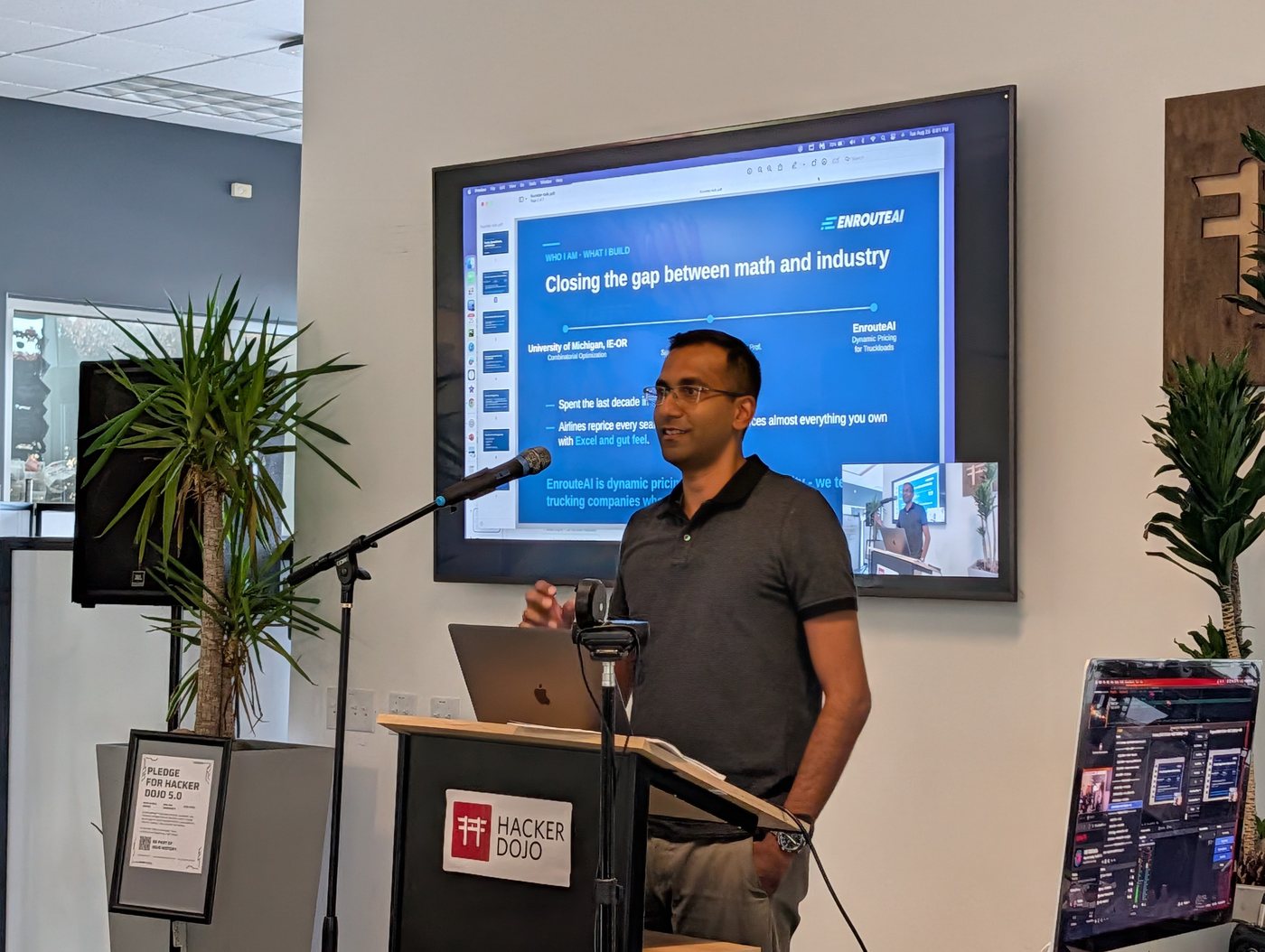
Founder and company introduction
Neil Fernandes built his expertise around transportation, operations research, and the mathematics behind routes, loading, capacity, and delivery economics. Working with an MIT professor also gave him direct exposure to the operational problems transportation companies face.
EnrouteAI is a bootstrapped freight-technology company that helps fleet owners decide what price they should charge for full-truckload capacity. This Playbook captures the customer-discovery and company-building lessons behind that journey.
02 · The problem
The freight-pricing problem
Airlines use sophisticated systems to price seats dynamically. Trucking fleets sell capacity in a similar way, but many still depend on spreadsheets and experience to decide what a full truckload should cost.
- Trucking fleets must decide what price to quote for the capacity on their trucks.
- Many carriers still price full truckloads using spreadsheets, intuition, and manual analysis.
- Routes, capacity, costs, and market conditions make truckload pricing difficult to do consistently.
- The pricing work must still be completed by a deadline whether or not a software product exists.
03 · The solution
Build the pricing engine behind the fleet’s decision.
EnrouteAI applies optimization to help fleet owners determine what price they should charge for full-truckload capacity. Neil’s larger point was that customers buy the completed pricing outcome—not the underlying AI, mathematics, or software.
04 · The founder journey
From transportation research to EnrouteAI
- 1Neil’s interest in transportation began early and continued through his master’s research.
- 2Working with an MIT professor exposed him to transportation companies and their operational problems firsthand.
- 3His first product focused on package-delivery optimization: route planning, truck loading, and bringing Amazon-like capabilities to smaller operators.
- 4Customer conversations and selling revealed a stronger opportunity in truckload pricing, so the same optimization foundation evolved into EnrouteAI’s current product.
- 5EnrouteAI operates with a small team and serves organizations ranging from roughly $1 million in revenue to a multi-billion-dollar U.S. enterprise.
05 · What was demonstrated
A framework for validating demand
The talk broke the approach into a practical sequence:
- 1Name a specific buyer—not an abstract persona
- 2Find a project that is blocked, urgent, and deadline-driven
- 3Use a mock-up or deliver the result manually
- 4Iterate until customers pull the solution from you
06 · Practical lessons
The operating lessons behind the company
Lesson 1
Demand exists before the product
Real demand is an important project that must be completed by a deadline, is currently blocked, and is urgent enough for the customer to act.
Lesson 2
Sell the outcome
Offering to complete a customer’s bid is easier to adopt than asking the customer to buy another product and change how the work gets done.
Lesson 3
Learn by selling
A mock-up, a manual service, and direct rejection can teach more than months of isolated product development or theoretical positioning.
Lesson 4
Let the startup evolve
EnrouteAI moved from package-delivery optimization to truckload pricing because customers exposed a stronger market problem.
Lesson 5
Find the first customer precisely
Identify a real decision-maker at a real company, then reverse-engineer where that person can be reached. Neil used industry conferences and cold calling.
Lesson 6
Look for customer pull
Strong sales is less about persuading reluctant prospects and more about finding buyers whose urgent, blocked work makes them ask for the solution.
Lesson 7
Use venture capital selectively
VC fits only some businesses. Raising before product-market fit can amplify the wrong decisions, and money cannot repair missing demand.
Lesson 8
Prepare for a long journey
Neil described entrepreneurship as a decade-long marathon, not an overnight path to wealth. Founders must manage expectations and avoid burnout.
Lesson 9
Treat the first hire as a founder-level decision
A poor first hire can seriously damage a young company. Trust, alignment, and introductions through a credible network matter greatly.
Lesson 10
Let customers determine the roadmap
EnrouteAI may eventually enter LTL, ocean, or air freight, but Neil will follow demonstrated customer pull rather than force a five-year prediction.
07 · The founder take
Build toward pull, not persuasion
The shortest path is to identify a specific buyer with urgent, blocked work, deliver the outcome before overbuilding, and let repeated customer pull determine what the startup becomes.
Validate urgency
A pain point becomes demand when the customer has a blocked project and a real deadline.
Deliver before scaling
Use mock-ups and manual execution to prove value before investing heavily in the product.
Follow the evidence
Allow customers, sales, and repeated use to shape the product and the company’s direction.
08 · FAQs
Questions from the talk
What does EnrouteAI do?+
EnrouteAI makes RFP (Request for Proposal) pricing software for truckload carriers. It helps fleets decide what to charge for full-truckload capacity when responding to freight RFPs.
How is EnrouteAI similar to airline pricing?+
Airlines dynamically price seats. EnrouteAI applies optimization principles to the capacity that trucking fleets sell.
Does EnrouteAI price less-than-truckload shipments?+
Not currently. Neil said the company’s present focus is full-truckload pricing.
What was Neil’s original product?+
It focused on package-delivery optimization, including route planning and deciding how trucks should be loaded.
How did the product move into truckload pricing?+
Selling and customer conversations revealed a stronger opportunity. The original optimization capability evolved to address that demand.
How should founders identify genuine demand?+
Find a customer project that is blocked, urgent, and tied to a deadline—not merely a general pain point.
Should founders build the complete product before approaching customers?+
No. Neil recommended starting with a mock-up or manually delivering the outcome so the founder can learn before overbuilding.
How did Neil find early customers?+
He showed up at specialized trucking conferences, spoke directly with specific decision-makers, and used cold calling.
Why does Neil prefer customer pull over persuasion?+
Customers facing urgent, blocked work adopt faster. A prospect who requires heavy convincing may buy temporarily and then churn.
Does Neil plan to raise venture capital?+
Not presently. He believes VC is suitable for only some companies and cannot compensate for missing product-market fit.
How large is the EnrouteAI team?+
EnrouteAI operates with a small team.
What matters when making the first hire?+
Trust, alignment, and a strong personal or network-based reference. Neil considers the first hire a high-impact decision that can harm the company if handled poorly.
Where will EnrouteAI expand next?+
Neil has not predetermined the answer. The company will follow demonstrated demand, whether that eventually leads to LTL, ocean freight, air freight, or another adjacent market.
What resources did Neil recommend?+
He explicitly recommended The Mom Test and Paul Graham’s early startup essays.
09 · Continue exploring