Industry
Trucking and freight
Started with
Delivery optimization
Found demand in
Freight RFP (Request for Proposal) pricing
Growth model
Bootstrapped and customer-led
Company snapshot
Operating context
Small
Team
Bootstrapped and customer-led
$1M
Smallest customer revenue
Approximate company revenue
Enterprise
Largest customer company
Multi-billion-dollar U.S. enterprise
2
Early acquisition channels
Trade conferences and cold calling
Customer-company size range
The reported annual-revenue range of companies served by EnrouteAI—from a small operator to a multi-billion-dollar U.S. enterprise.
Logarithmic visual scale. These figures describe customer-company revenue—not EnrouteAI revenue, valuation, or customer count.
The case study
A product direction discovered through customer pull
The path was not a straight line from idea to product. Domain knowledge, direct selling, and an urgent customer deadline combined to reveal the business EnrouteAI should become.
Understand the case visually
Four models explain what changed
Starting insight
Optimize package-delivery routes
New capability
Understand the cost of serving a load
Market pull
Price full-truckload capacity
Blocked
The customer cannot complete important work today.
Urgent
The project is important enough to act now.
Deadline
A real date creates consequences for delay.
Product push
“Buy our pricing software.”
Requires persuasion, workflow change, and continued convincing. A weak fit can produce churn later.
Customer pull
“Price this bid before our deadline.”
Starts with an outcome the customer already needs. Urgency makes the value and adoption path clear.
- 01
Show a mock-up
- 02
Deliver manually
- 03
Observe customer pull
- 04
Build the repeatable product
Each cycle reduces assumption and increases evidence. The product becomes the repeatable version of an outcome customers already pulled from the founder.
01
The context
Domain expertise shaped the starting point
Transportation had interested Neil since childhood. He later studied it during his master’s program and worked with an MIT professor, where he saw the operational problems faced by transportation companies firsthand.
He understood the mathematics behind route planning, loading, capacity, and delivery economics. The opportunity appeared to be bringing capabilities used by companies such as Amazon to smaller operators that could not build large optimization teams.
02
The original bet
Make advanced delivery optimization available to everyone
Neil’s first product helped plan package-delivery routes and determine how a truck should be loaded. It was technically connected to a real industry problem—but that did not automatically make it the right business.
The initial product became a starting point rather than the final destination. The underlying optimization capability was valuable; the market still had to reveal where that capability was most urgently needed.
03
The challenge
Good technology did not remove adoption friction
Fleet operators already had processes, spreadsheets, deadlines, and people responsible for pricing. Asking them to adopt a new product created resistance even when the technology was strong.
Neil realized that a general pain point is not the same as demand. Customers experience many problems, but they act only when important work is blocked and time is running out.
“People do not buy products. They buy a solution to the problem they have.”
04
The discovery
Demand is a blocked project with a deadline
Truckload carriers must submit prices for their capacity whether EnrouteAI exists or not. That pricing project is the demand. The stronger offer was not ‘buy our pricing software’; it was ‘we will price this bid before your deadline.’
That distinction changed both the message and the way Neil evaluated opportunities.
- There is a specific project the customer must complete.
- The customer is blocked by current tools, knowledge, or capacity.
- The project is urgent and attached to a real deadline.
05
The action
Find one real buyer, show up, and learn by selling
Neil replaced abstract personas with a concrete hypothesis: a specific pricing leader at a specific trucking company. From there, he worked backward to find where those buyers gathered.
Specialized trucking conferences and cold calling helped him reach early prospects. Instead of waiting for a finished product, he recommended showing a mock-up or completing the work manually to learn what customers would actually pay to solve.
- Name the exact decision-maker and company.
- Go where that buyer already spends time.
- Show the outcome with a mock-up before overbuilding.
- Use rejection and manual delivery to shorten the learning cycle.
06
The turning point
Customer pull moved the company into truckload pricing
The original delivery product evolved as customers exposed a stronger opportunity. If route optimization could reveal the cost of serving a load, the same foundation could help determine what that truck capacity should be sold for.
EnrouteAI became a pricing engine for full-truckload fleets. The product direction came from repeated market evidence—not from protecting the original idea.
07
Where it stands
A focused, bootstrapped business serving very different fleet operators
EnrouteAI operates with a small team. Its customers range from a business with roughly $1 million in revenue to a multi-billion-dollar U.S. enterprise.
The talk did not present a predetermined five-year expansion plan. Neil’s position was that the next market—whether LTL, ocean freight, air freight, or something else—should be decided by demonstrated customer pull.
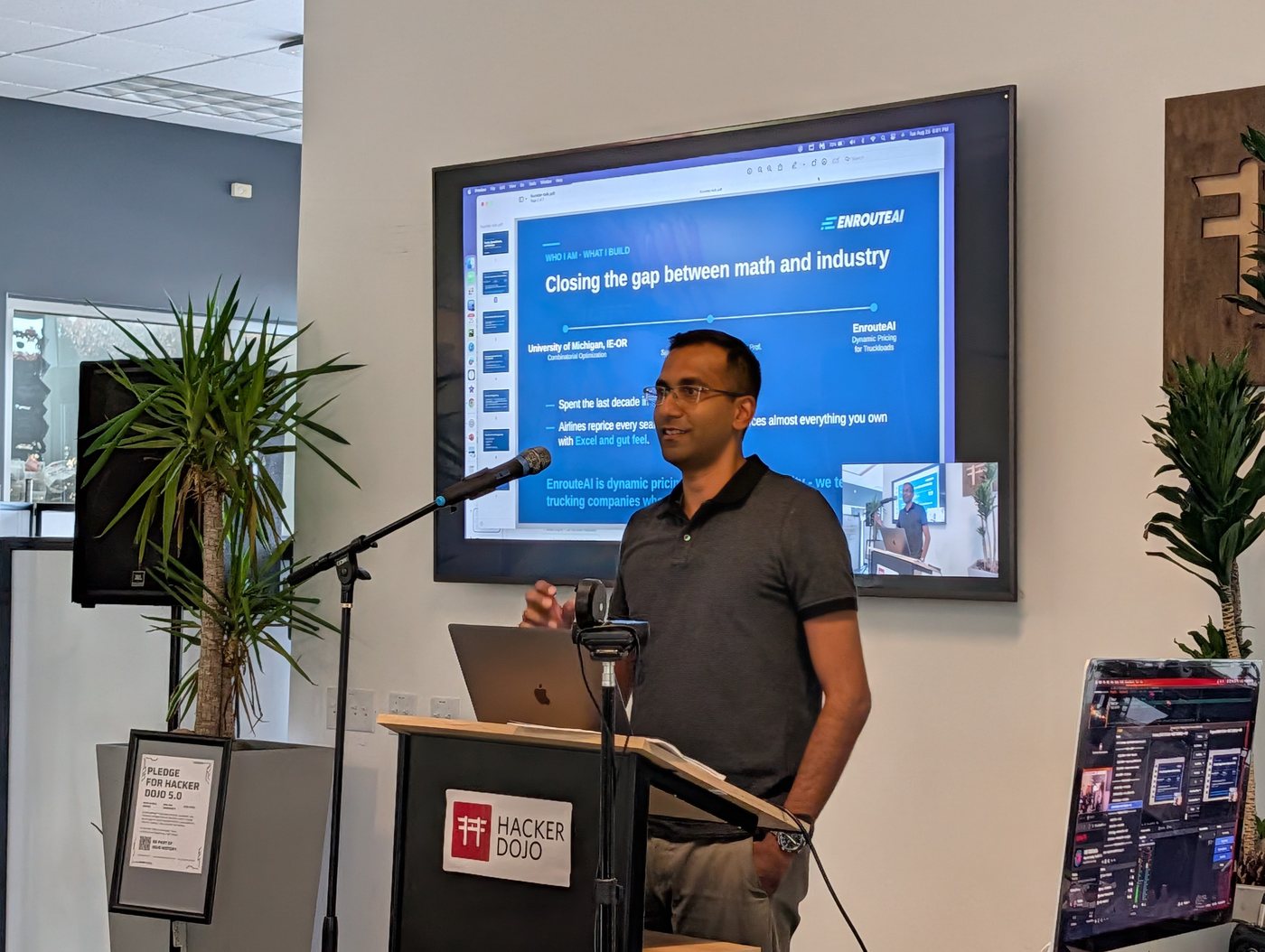
From the StartupA2Z session
“You learn by selling.”
A practical message for early founders: a mock-up, a direct customer conversation, and even rejection can reveal more than months spent perfecting a product in isolation.
Continue exploring